AI context and memory exploration
Context Capsules are a proposed UI/SDK layer that gives users direct control over what an AI remembers, when, and why. This exploration started as a personal whitepaper in August 2025 and evolved into a set of mockups for an MVP focused on developer use cases.
Why this exploration? #
LLMs can process millions of tokens but still forget what you asked an hour ago. They remember the name of your cat and forget the business-critical constraint you repeated three times. Memory systems shipped by major providers made things murkier rather than clearer — users don’t know what’s stored, what leaks between sessions, or how to correct it.
Prompt engineering is a band-aid. Context engineering is a step forward, but users still can’t see or control what’s being remembered. The cost is real: workflow friction, declining trust, and abandonment of otherwise powerful tools.
The proposal #
A Context Capsule is a lightweight, human-facing container for the stable signals an AI needs to behave well in a given domain:
- Intent and use-case (“I use this AI for therapy, summarizing reports, daily writing”)
- Stack and style (Python 3.11, Black, TypeScript + ESLint)
- Constraints (“never rename variables”, “retain schema field order”)
- Tone and verbosity (“no praise, minimal explanations”)
- Mode — a behavior contract: Code Agent, Auditor, QA, Mentor
Capsules sit alongside automated memory rather than replacing it. The default behaviour stays seamless; user-selected capsules override, redirect, or reinforce model memory when it matters.
Design principles #
- Effortless and frictionless. The UI layer must remain intuitive and minimal. Capsules integrate with existing interaction flows.
- Intent as alignment. Capsules capture intent and inject it in relevant sessions to save the user time.
- Identity through context. Capsules let the user seamlessly switch identities to tackle distinct tasks without leakage between them.
MVP focus: developers #
Developers waste hours repeating the same guardrails (“don’t rename variables”, “don’t touch other files”) across sessions and files. Capsules bind to a repo, auto-activate when the project opens, and expose a one-keystroke mode toggle (@auditor, @qa, @agent).
Two personas drove the MVP exploration:
- Luke Jo — corporate maintainer by day, learner by night. Auditor mode on the financial pipeline at work, Mentor mode on his Space Invaders side project at night. Same person, two trust contracts.
- Dr. Lee — clinical healthcare analyst. QA-only mode for cardiovascular risk review. No dosage autocomplete, no equation rewrites, no edits.
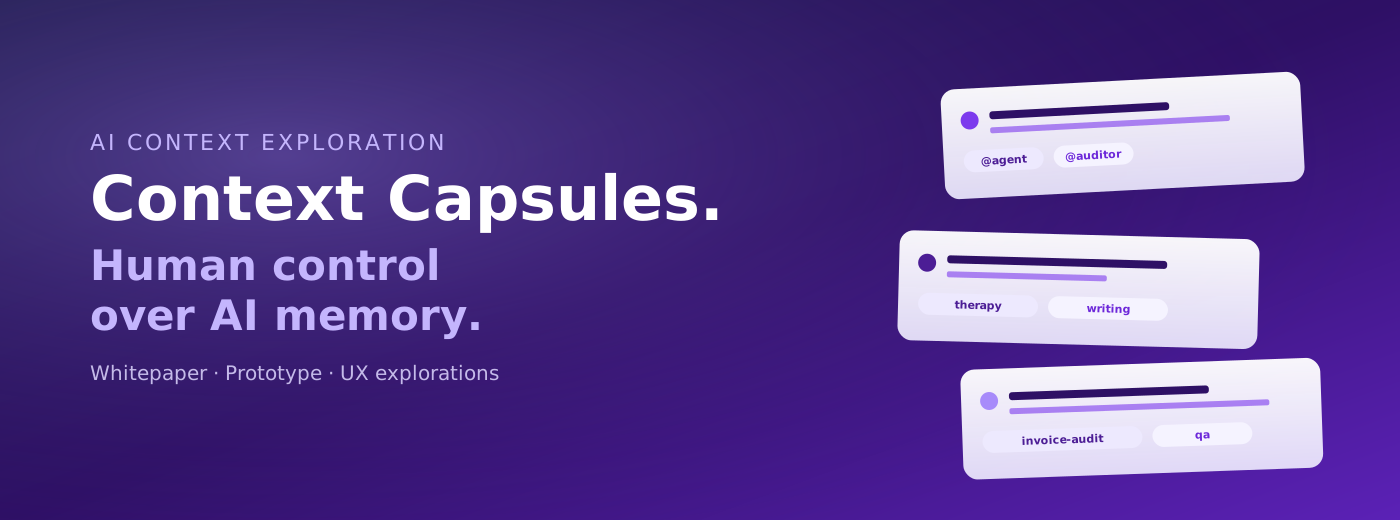
The mockups on the right show how a capsule surfaces these signals in a compact, scannable card.
Deliverables #
- Whitepaper — full write-up of the problem, proposal, use cases, and MVP scope. Read the whitepaper.
- Mockups — capsule cards for the two developer personas, included below.
My role #
- Authored the whitepaper end-to-end: problem framing, proposal, design principles, use case mapping.
- Designed the capsule data model and mode contracts (Allowed / Forbidden / Output schemas).
- Produced the mockups for the developer MVP.
Status #
Exploratory. The whitepaper is published as open thinking under CC BY 4.0. The ideas continue to inform my work on AI tooling — including zapcoach.me and ongoing experiments with local and cloud LLM stacks.

