EY.com
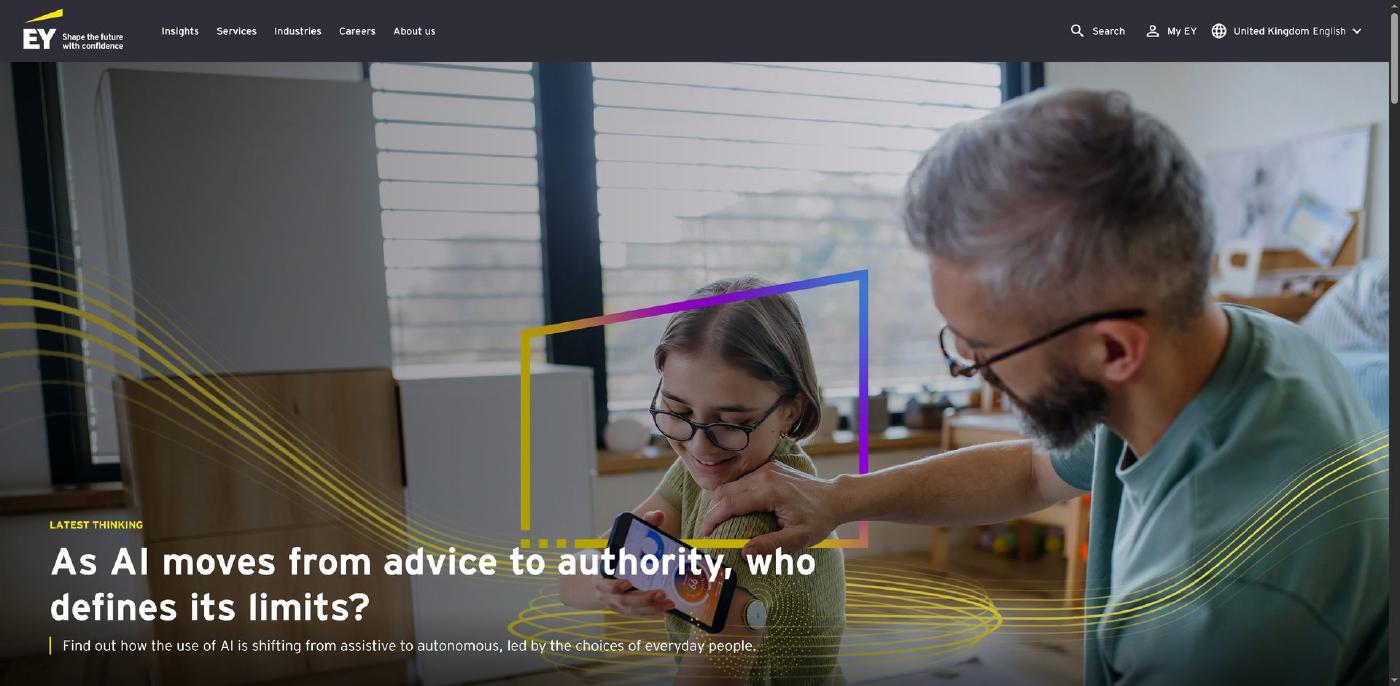
EY.com is the client-facing side of EY. Leading the Global User Experience function, my team helped EY to take a exponential leap in customer experience and marketing performance.
Why EY.com? #
EY had a fragmented digital presence that was hard to navigate by users. Navigation was confusing, content was often redundant or duplicative, the digital experience was not on par with what clients expected.
EY operates across 140 countries with more than 450k employees and ambitions to reach $50B in annual revenue in 2027. For a professional services firm of this scale, the website is a primary credibility signal in B2B sales. The gap had real commercial cost.
A multi-year digital transformation program revolutionized the way EY produces content and goes to market. A new digital experience was created to express the best of EY in the market.
My role #
- Built and led the Global Digital UX function. ~12 distributed people, fully remote, multi-disciplinary.
- Directed the redesign of ey.com and global rollout to 140+ countries.
- Led user research including face-to-face interviews with global C-suite executives.
- Owned global/local content strategy on AEM, including newsletter and email channel transformation.
- Partnered with world-class agencies to bring design knowledge in-house (Wunderman Thompson, EY-Seren, Cognified).
- Stepped in as interim Product Manager for testing and personalization (Adobe Target).
Highlights #
Sequenced multi-year program. User research in 2017. Initial ey.com launch in 2018. Global rollout to 140+ countries through 2019. Newsletter and Global/Local content strategy in 2020. Each phase fed the next.
C-suite research grounded in real buyers. Mixture of quant and qual research. Conducted face-to-face interviews with global C-suite executives, not assumed personas. The findings shaped navigation, content priorities and the tone of the experience. Insights also drove decisions beyond digital channels.
Pitched and won transformative programs at C-level. Worked closely with senior leadership accross brand, marketing, markets and IT to sign off strategic work: experience strategy, experience design deliverables, future state direction, global/local content strategy, email strategy, etc.
140-country governance and enablement. Rolled out a single experience and content redesign while prioritizing local relevance. Required alignment across business, marketing leads, content and experience community. The AEM translation and live copy mechanism added a layer of complexity to the localization and governance.
Stepped in as Product Manager for testing and personalization. Took Adobe Target from POC into the production marketing stack. Defined the maturity roadmap for A/B testing and personalization across the firm.
Impact #
Drove user research into decisions across the firm. Findings from quant and qual studies (including face-to-face interviews with global C-suite buyers) were used by partners across brand, markets and IT to align on direction. Some of the work shaped decisions beyond digital channels.
Resolved the global/local content tension. Plotted every content type on two axes: global to local, consistent to flexible. Co-developed with leaders and practitioners across markets, it allowed all parties to manage competing business needs through process rather than ad-hoc negotiations. This removed a lot of wasted effort and tension from the system. i.e. Service pages: globally consistent and tightly governed. Articles and thought leadership: room for local interpretation.
Unified the email channel into a user-centric experience. Replaced scattered, partly dormant newsletters with one subscription system aligned to user interests. Reduced data compliance risk, removed user confusion, made the channel measurable. Open and click-through rates improved across the consolidated lists.
Enabled a community of 1,000+ content and experience creators globally. The Digital Playbook gave non-UX colleagues the tools to do their work well: how to use the components, what good looks like, how to measure, how to improve. Saved time across the network and raised the floor on experience quality.
Governed taxonomy to stop user confusion and SEO cannibalization. Before: ten pages on “digital transformation” from different parts of the firm, fighting each other for ranking and user attention. After: one canonical page per service, with content from across EY consolidated rather than competing. Better SEO, navigable site, easier user journey.
Increased lead conversion by orders of magnitude. Working with brand, marketing and the digital transformation team, moved from a content site with uncertain conversion paths to a CTA-first experience. Every article carries an invitation to subscribe to Editor’s Picks. Every service and practitioner page features prominent contact routes. Lead volume and quality improved accordingly.


