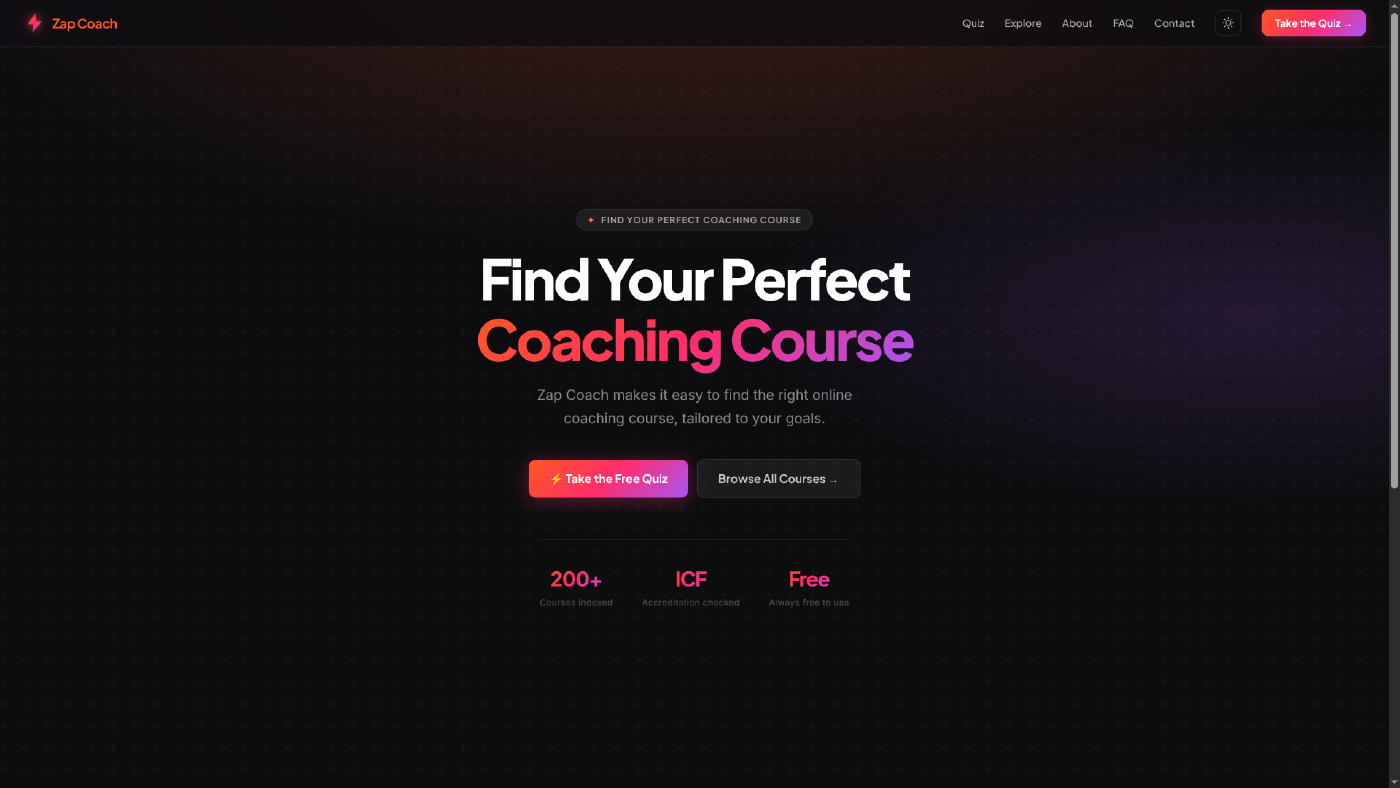
zapcoach.me
Zapcoach makes it easy to find coaching courses through an AI-powered recommendation engine.
Why zapcoach.me? #
Coaching is a $5.34B global industry with 122,974 active practitioners worldwide (ICF, 2025). Online coaching alone is projected to reach $4.5B by 2028. The market is growing fast but the search and discovery user experience is broken.
Reputable institutions (Universities like Oxford or Brown) bury you in academic process. Campuses, credits, prospectuses, multi-page PDFs. You wanted to sign up for a coaching course. You ended up reading a university handbook.
Other platforms (Udemy, Skillshare) and specialist providers miss the ‘how to’ layer entirely. They expect you to know the difference between ICF, EMCC and BCC. First-time users have no chance.
Content is business-centric (what we offer) and there’s no unified user-centric discovery engine (what type of learning you’re looking for? how much time and money are you willing to invest?).
What’s missing across all three: a user-side starting point. Zapcoach starts there. Tell us four things in two minutes:
- Topic of your coaching course (business, life, health, spiritual, relationships).
- What you plan to do with it (become a coach or upskill).
- How you want to learn (self-paced or cohort).
- Your time and money budget.
We do an honest, curated review of providers and courses. We recommend the courses that match your needs.
My role #
- Ideated, developed and shipped the product end-to-end.
- Created AI-powered data pipeline to fetch updated course data.
- Created recommendation algorithm based on user needs.
- Created 2-minute quiz and exploration engines to easily find courses.
Highlights #
Data-led design. Niches, accreditation, price thresholds, course length. Every quiz dimension reflects evidence-based market and user patterns.
Algorithmic user experience. Hard constraints filter the catalogue first (e.g., never show a non-ICF course to an ICF-seeking user). Soft constraints then rank what remains by weighted preference. Recommendations stay relevant and deterministic: same answers yield consistent results.
Privacy by design. No user data stored or processed. Anonymous, session-based analytics. Affiliate links built to work with uBlock Origin and Firefox anti-tracking, so users on privacy-conscious browsers actually reach providers without breaking the referral.
Hybrid LLM stack. Cloud models (Opus, Sonnet) handle heavier reasoning. Local Qwen models handle lighter inference. Keeps cost sustainable while a beta product is finding its shape.
Status #
In beta. Refining recommendations and the quiz flow based on early user feedback.
Tech stack #
- Frontend: Next.js 15, React 18, TypeScript, Tailwind CSS
- Data pipeline: Node.js, Crawlee + Playwright for fetching, local LLM for extraction, deterministic verification (every claim matched back to a verbatim quote on the source page) before publication.
- IDE: VS Codium + Roocode / Claude Code / Qwen Code


